Copper outlook remains positive with room for growth
Aug 16, 2026
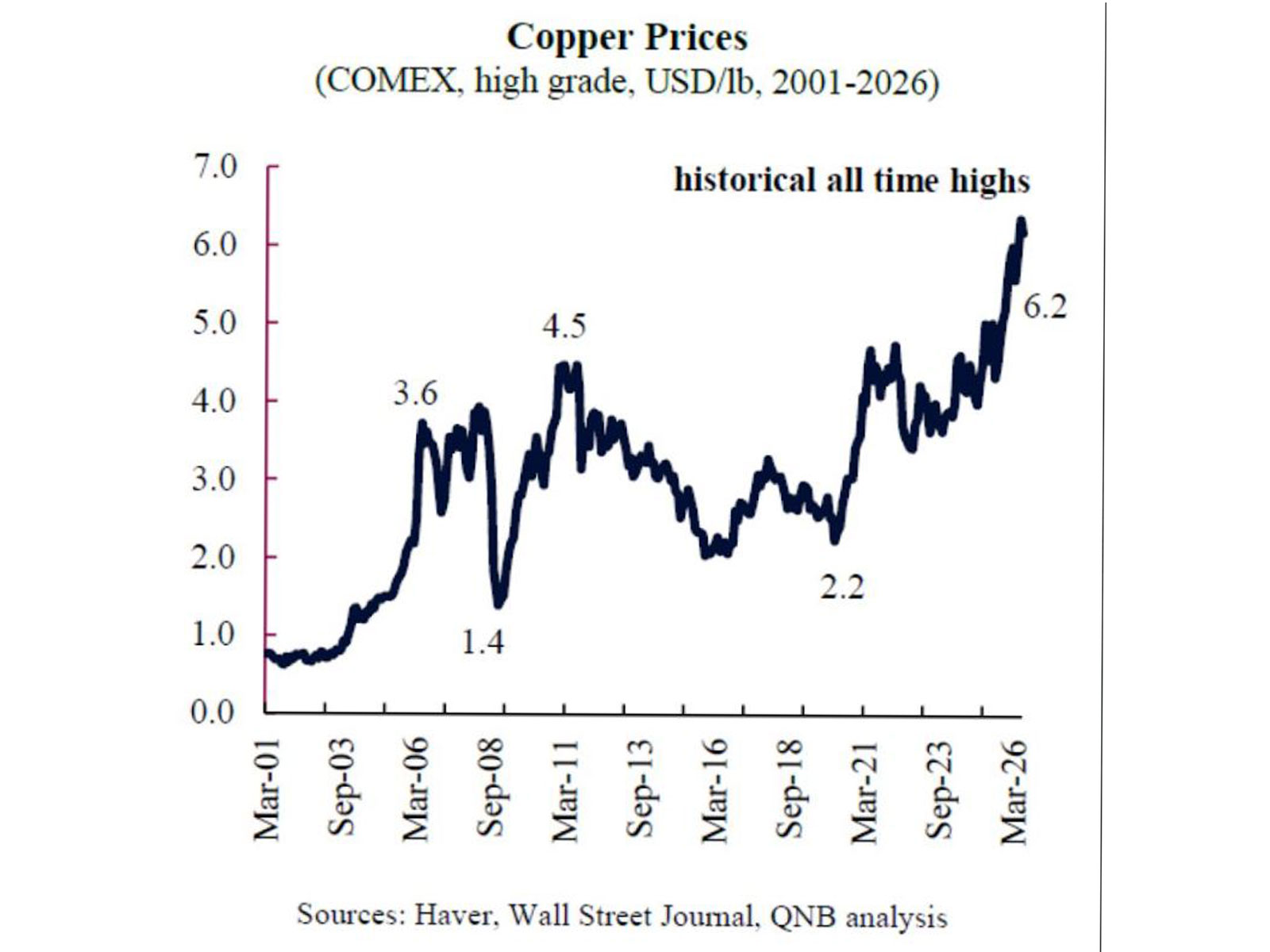
Doha [Qatar], August 16: Copper has long served as one of the most reliable barometers of global economic health, earning its reputation as "Dr. Copper" for its ability to anticipate the direction of investment cycles and industrial activity. In previous articles, QNB Economics had identified tailwinds that pointed to a sustained period of higher prices. At approximately $6.20 per pound, copper has broken multi-year highs. This article elaborates on the structural forces of copper demand and supply and assesses how they have evolved.
Despite copper's remarkable price appreciation in recent years, the metal remains attractively valued when assessed against a longer historical trajectory. Adjusted by US consumer price inflation, copper prices remain meaningfully below their 2008 peak during the commodity super-cycle. At this time, a Chinese-led urbanisation boom drove an unprecedented surge in industrial demand.
While gold and several precious metals have appreciated significantly in real terms over the past 15 years, copper has broadly tracked US inflation rather than outpaced it. This suggests that current price levels are not yet pricing in the full magnitude of copper's structural demand expansion. Copper's relative affordability also implies that the global economy retains a meaningful capacity to absorb further price increases. In this sense, the valuation is not only intact but arguably more compelling today, as the demand forces underpinning it have continued to strengthen.
The global energy transition remains the most powerful and durable long-term demand driver for copper. Renewable energy technologies, such as wind, solar, and hydropower, require two to five times more copper per unit of capacity than traditional fossil fuel-based power generation.
Grid modernisation, the expansion of transmission networks, large-scale battery storage, and electric vehicle charging infrastructure all require substantial copper inputs. Electric vehicles alone are particularly copper-intensive, requiring up to four times more copper than conventional internal combustion engine vehicles, and charging infrastructure adds further to this.
Critically, these demand drivers are largely insensitive to short-term macroeconomic conditions. Policy frameworks, national decarbonisation targets, and corporate transition commitments continue to underpin multi-year investment cycles in renewable capacity and grid infrastructure across both advanced and emerging economies. As electrification becomes the common denominator of virtually every major decarbonisation pathway, copper's role as the foundational enabler of the energy transition becomes increasingly irreplaceable.
Alongside the energy transition, the explosive emergence of artificial intelligence has created significant new demand for copper over the last years.
AI data centers, high-performance computing infrastructure, and advanced semiconductor facilities are extraordinarily electricity-intensive assets. This surge in power consumption is accelerating grid stress, forcing utilities to expand capacity and invest in more resilient transmission systems, all of which are copper-intensive undertakings. Beyond the grid, hyperscale data centers are themselves significant consumers of copper, from transformers and wiring to cooling systems and backup power infrastructure. As AI adoption broadens across industries, data centers are becoming one of the fastest-growing sources of incremental copper demand, with the potential to rival electric vehicles in their long-run contribution. Critically, this demand vector is still in the early stages of being priced into long-term copper outlooks, suggesting that its full impact on market balances lies still ahead of us.
While demand continues to expand on multiple fronts, the supply side of the copper market remains structurally constrained. Mine production growth is flat in 2026, with major producers including Codelco, the world's largest copper miner, continuing to underperform relative to capacity. Capital expenditure in the mining industry remains insufficient relative to asset depreciation which means the industry is not investing at a pace to keep up with demand growth.
This underinvestment is aggravated by the structural characteristics of copper mining itself: from discovery to full production, major copper projects typically require 10 to 15 years of development.
No meaningful new supply commissioned at current price levels can therefore reach the market before the early 2030s at the earliest. In the interim, smelters and refiners have been drawing on scrap and secondary sources to maintain output, but this is a bridging mechanism rather than a structural solution. The supply gap is not closingit is deepening.
In summary, real prices remain below the 2008 super-cycle peak, preserving the valuation argument and suggesting meaningful room for further appreciation. On the other hand, the structural forces shaping copper's outlook have strengthened. Demand is expanding across the two dimensions, the global energy transition and the AI infrastructure development and expansion. Supply on the other side, cannot respond at pace which will deepen the structural deficit over the next years.
- By QNB Economics
Source: Qatar Tribune